Coins
|
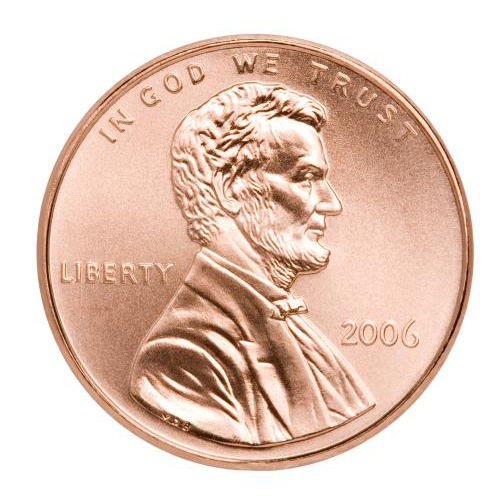
The penny was the first coin authorized by the United States under the Coinage Act of 1792, with production beginning in 1793. Early pennies were much larger than today’s, made entirely of copper, and carried designs symbolizing liberty. The Fugio cent of 1787, struck by a private mint before the official U.S. Mint opened, is often considered the nation’s first one‑cent coin. Throughout the 19th century, the penny underwent several design changes. The Flowing Hair cent and Liberty Cap cent emphasized freedom, while later designs like the Flying Eagle cent (1856) and Indian Head cent (1859–1909) reflected evolving artistic styles. Copper shortages during the War of 1812 even halted penny production in 1815. In 1909, the penny took on its most enduring design: Abraham Lincoln’s portrait, created by Victor David Brenner, to mark the centennial of Lincoln’s birth. This was the first time a U.S. coin featured a president. The reverse initially showed wheat stalks, later replaced by the Lincoln Memorial in 1959, and most recently by the Union Shield design in 2010, symbolizing Lincoln’s preservation of the Union. The penny’s composition also shifted over time. Originally pure copper, it became bronze in the mid‑1800s. During World War II (1943), pennies were made of zinc‑coated steel to conserve copper for the war effort. Since 1982, pennies have been primarily zinc with a thin copper plating, a cost‑saving measure. Despite its low value, the penny has remained a cultural icon. It is tied to sayings like “a penny saved is a penny earned” and customs such as tossing pennies into fountains for luck. In recent years, however, debates have emerged about eliminating the penny due to its production cost exceeding its face value. |
|---|