Coins
| |
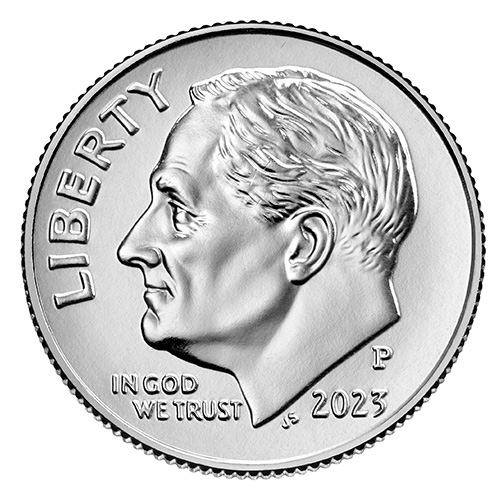
The dime is the smallest coin in diameter and thickness among U.S. currency, measuring 17.91 mm across and 1.35 mm thick. Despite its size, it carries a value of ten cents, making it more valuable than both the penny and the nickel. Its edge is reeded with 118 tiny ridges, a feature originally designed to prevent shaving off bits of silver when the coin was made of precious metal. On the obverse (front), the dime displays a left‑facing portrait of President Franklin D. Roosevelt, who has appeared on the coin since 1946. Above his head is the word “LIBERTY”, while “IN GOD WE TRUST” appears to the left of his profile. The year of minting is inscribed to the right, along with a mint mark indicating where the coin was produced. Roosevelt’s image was chosen to honor his leadership and his association with the March of Dimes campaign. On the reverse (back), the dime features a torch in the center, symbolizing liberty. To the left of the torch is an olive branch, representing peace, and to the right is an oak branch, symbolizing strength and independence. Surrounding these symbols are the inscriptions “UNITED STATES OF AMERICA”, “E PLURIBUS UNUM” (Latin for “Out of many, one”), and “ONE DIME”. This design, created by John R. Sinnock, has remained unchanged since 1946, making it one of the longest‑running coin designs in U.S. history. The dime’s color and feel come from its composition: a copper core clad in nickel, giving it a silvery appearance. This change was introduced in 1965, when rising silver prices made it impractical to continue minting dimes in 90% silver. Today’s copper‑nickel clad dimes are durable, resistant to wear, and easy to distinguish from other coins by their size and ridged edge. |
|---|