Countries of the World: Afghanistan Argentina Australia Belgium Brazil Canada Chile China Colombia Democratic Republic of the Congo Denmark Egypt Ethiopia Finland France Germany
The history of Germany
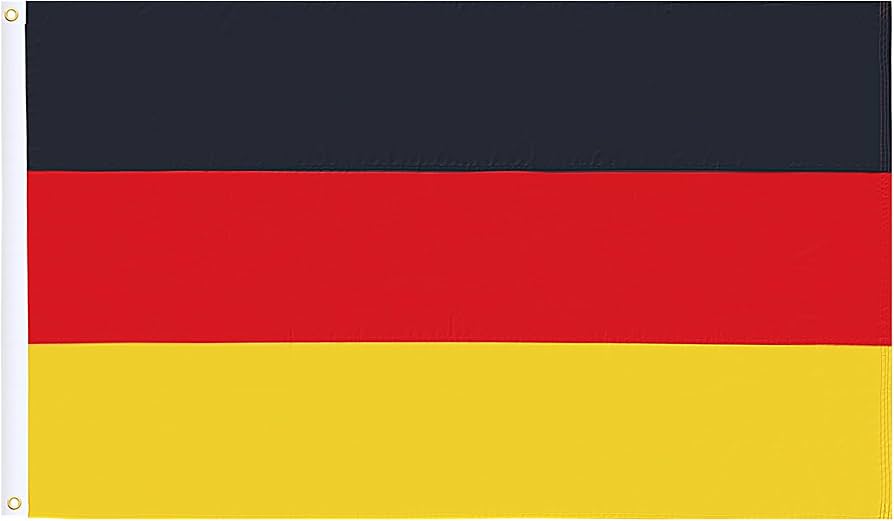
is a long and complex narrative spanning millennia, characterized by political fragmentation, cultural brilliance, devastating wars, and a remarkable modern trajectory toward democracy and reunification. The German flag, a horizontal tricolor of black, red, and gold, mirrors this turbulent journey, representing the enduring German dream of unity and freedom through various regimes and political upheavals.
A Summary of German History
Early History and the Holy Roman Empire
Germanic tribes interacted with the Roman Empire from as early as 113 BCE, with the Rhine river eventually establishing a boundary. Following the collapse of Roman authority, the Franks rose to prominence. Charlemagne was crowned Holy Roman Emperor in 800 CE, establishing a vast realm that was later divided by the Treaty of Verdun in 843 CE, out of which the Eastern Frankish Kingdom—the precursor to modern Germany—emerged.
This entity evolved into the Holy Roman Empire, a loose collection of hundreds of kingdoms, duchies, principalities, and free cities that existed until 1806. It was a period marked by decentralized power, internal conflicts (such as the Investiture Controversy), the power of the Hanseatic League, and major cultural shifts like the Protestant Reformation initiated by Martin Luther in 1517. The devastating Thirty Years' War (1618–1648) ended with the Treaty of Westphalia, confirming the near total independence of the German states and further weakening central imperial authority.
Rise of Prussia and Unification
From the 18th century, the Kingdom of Prussia emerged as a major power, challenging Austrian dominance in German affairs. The French Revolutionary and Napoleonic eras dissolved the old order; Napoleon's conquests led to the abolition of the Holy Roman Empire in 1806 and fostered a growing sense of German nationalism among the people.
In 1871, following the Franco-Prussian War, Otto von Bismarck successfully unified the German states into the German Empire
(Second Reich) under the leadership of the Prussian King Wilhelm I. This new state was a powerful, industrialized monarchy that became a leading European power.
World Wars and Division
The German Empire's ambitions and foreign policy contributed to the outbreak of World War I (1914–1918). Defeat led to the abdication of the Emperor and the establishment of the democratic Weimar Republic
. The Republic faced immense challenges, including the punitive Treaty of Versailles, hyperinflation, and political extremism.
In 1933, Adolf Hitler and the Nazi Party rose to power, establishing the totalitarian Third Reich
. This regime initiated the systematic persecution and murder of millions (the Holocaust) and triggered World War II in 1939 with the invasion of Poland. After Germany's defeat in 1945, it was occupied by the Allied powers and divided.
The post-war era saw Germany split into two states: the Western-allied Federal Republic of Germany
(West Germany) and the Soviet-controlled communist German Democratic Republic
(East Germany). The city of Berlin was similarly divided, becoming a central point of the Cold War, highlighted by the construction of the Berlin Wall in 1961 to stop the flight of people from East to West.
Reunification and Modern Germany
Mass protests in East Germany and the collapse of communist regimes across Eastern Europe led to the fall of the Berlin Wall in November 1989. This paved the way for German reunification on October 3, 1990, bringing the two Germanys back together as a single, democratic and sovereign federal republic. Germany is now a leading member of the European Union and a stable democracy.
The History of the German Flag
The modern black-red-gold flag has a history intertwined with the struggle for a unified, democratic Germany:
Origins (Early 19th Century): The colors originated from the black uniforms with red piping and gold buttons of the Lützow Free Corps, a volunteer unit that fought against Napoleon's forces during the Wars of Liberation (1813–1815). Students and academics in the corps adopted these colors, which quickly became a symbol of German nationalism, unity, and bourgeois freedom. A popular interpretation of the colors at the time was: "Out of the blackness (servitude), through red (bloody) battles, to the golden (light of) freedom".
1848 Revolutions: The tricolor first appeared prominently at the Hambach Festival in 1832 and became the primary symbol of the liberal, democratic revolutionaries during the 1848 March Revolution. The short-lived Frankfurt Parliament officially declared black-red-gold as the national colors of the German Confederation.
German Empire (1871–1918): After the revolution failed, Bismarck's new German Empire adopted a black-white-red tricolor, combining the colors of Prussia (black and white) with the Hanseatic League (red and white). The black-red-gold flag was associated with the democratic opposition.
Weimar Republic (1919–1933): After WWI and the end of the monarchy, the black-red-gold flag was reintroduced as the national flag of the new Weimar Republic, symbolizing continuity with the 19th-century democratic movement.
Nazi Germany (1933–1945): The Nazis banned the black-red-gold flag and replaced it with their own flag featuring the swastika, while initially also using the black-white-red imperial colors.
Post-WWII and Modern Era: After World War II, both West Germany (Federal Republic of Germany) and East Germany (German Democratic Republic) initially used the black-red-gold tricolor. West Germany kept the plain tricolor, which was officially adopted into its Basic Law on May 23, 1949, as a symbol of democracy. East Germany later added its socialist coat of arms to its flag in 1959. With the reunification in 1990, the plain black-red-gold flag of the Federal Republic became the official flag of all of Germany, a widely respected symbol of national unity, democracy, and freedom.
|
 |