Aucester Boxlow Camble Chigley Clandon Dagon Docksedge Edgefield Edgewater Franckerton Regentsbridge Skurnam Stanton
Stanworth The Docks The Thumb Trumpton Village Spotlight: Stanton Wick Visit Us!
A map of the Roseport STS. Hover over it to see a to-scale map of Roseport, deformed slightly to better match the transit diagram. |
Roseport's transit system is known as the STS, short for Subterranean Transportation Service. The system first opened in 1872 with the creation of the Dagon and Stanworth Electric Railway, today known as the Dagon Line. The system as a whole has 106 stations across 10 lines. These lines are as follows: Seaview Line Skurnam Shuttle Dagon Line Dalcombe Line Denton Line Canton Line Clandon Line Conford Line Crescent Line Cumberland Line The whole system has undergone major renovations since 1997, which marked the opening of the Crescent Line. The system continues to expand, with more stations, lines, and connections planned to help better serve the city. Learning to ride the STS will make you trip a lot more fun! |
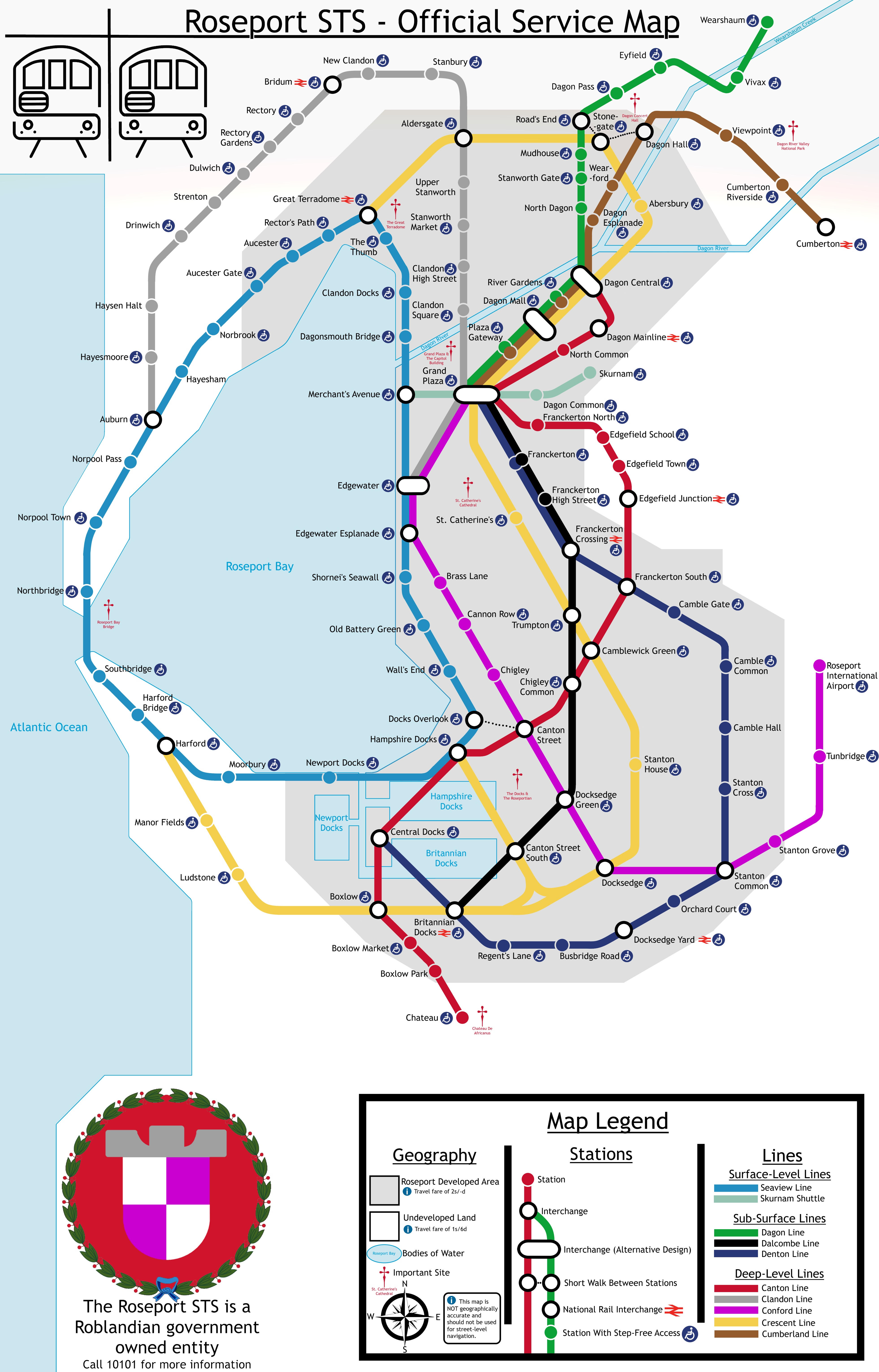
Fares Roseport Developed Area (grey): Flat fare of 4d Increases by 1d for every station travelled until 2s/-d (20 stations) Undeveloped land (white): Flat fare of 3d Increases by 1d for every station travelled until 1s/6d (13 stations) Notes: •Crossing over the Roseport Developed Area border increases ticket cost by 2d and increases maximum fare to 2s/6d. Crossing over the border again doesn’t do anything. •OSIs (marked by dotted lines) do NOT increase “penny counter.” •Shortest journey assumed (OSIs are counted DIFFERENTLY from this because they can track if you left the service or not) |
A video of the London Underground's Piccadilly Line. The Tube and the STS are very close in design, construction, and history. |
Below is some history, information, and writing about the Roseport STS:
The Great Terradome You’re on vacation. You are searching for your nearest train station in an unfamiliar city called “Roseport.” However, you get much more than you bargained for… As you walk along the tight bends and tree-lined streets near your hotel, you see that the road starts to open up. You have a passing thought that that could be the station, but nothing can prepare you for what you are about to see. This station is unlike any other you’ve ever seen. It faces towards the sea, its magnificent facade topping with an enormous dome. The facade bears resemblance to buildings of French or Roman architecture, while the dome itself is made of green copper, featuring 4 massive windows with gilded trim. The station is topped by a grand flagpole. As you enter, you pass through a marbled entrance, with the words “GREAT TERRADOME STATION” carved into the building’s marble. On the inside, you can’t help but wonder: where are the trains? There are departure boards and shops, but the trains are nowhere to be seen. You ask a local, and the point to enormous set of escalators, stairs, and inclinators. You walk onto the escalator, to this supposed “station”… But this is more like an underground city than a station. The walls and ceiling are built of brick, a far cry to the marble of the surface and the cream-and-brown plaster inside. To the left, there are the National Rail platforms, all 16 of them, each marked by a sign featuring the station’s name. To the right, a labyrinth of shops and wares, ranging from knick-knacks to premium goods. It even crossed over the tracks on a bridge at one point, the latter being far below, appearing almost like a river. Sandwiched in the middle is a station on Roseport’s metro, on the yellow line: Crescent. However, on the map, it’s marked as an interchange with another line: the light blue line: Seaview. But where is this other line? You look around for clues. Very quickly, you find one: a sign marked with 2 arrows. One has a step-free marker and just leads back the way you came. The other, however, leads to a whole new route. You climb up some green-carpeted stairs and arrive at a crossroad. One way goes back to the surface, but the other goes deeper underground. You follow the sign saying to take the latter. The cream walls with brown accents, combined with the green carpet and black light fixtures create a peaceful, but somewhat liminal space. It is so deep underground that it is completely silent. However, you see light at the end of the tunnel in the form of 2 shafts: a stair shaft and an elevator one. You opt for the elevator and find yourself at ground level, across the huge square from the Terradome. You turn around and look at the view South from the station, and take joy in knowing that this grand piece of infrastructure is the station you will use for the remainder of your vacation. |
The Abandoned Conford Line Cathedral Shuttle
There are only 2 closed stations on the Roseport STS network, and only 1 abandoned one. But why do they exist? Let’s look at their history, closure, and the almost-tragedy that led to the axe falling down. The year is 1927. Roseport and Dagon are rapidly closing in on the countryside in between them. Railways connect the 2 cities, but none covers the much-needed middle- -ground between the coast and the foothills of the Dagon Mountains. This is where the Conford Line comes in. It roughy parallels the Seaview Line, but more further inland. The area it traversed at the time was mostly rural, but was rapidly developing, especially along the coast and major rail lines, like the Denton and Dalcombe lines. The line’s original terminus was at Canton Street, but there was a problem: there was no real reason for people to actually take the line. The Seaview line was most convenient for commuters, and stole most of the Conford line’s traffic. The Conford line needed some that to set it apart: a shuttle to a major site: Saint Catherine’s Cathedral. The project was greenlit after abysmal passenger numbers in the first year, and the project went ahead. The branch starts at Cannon Row station, which was expanded on for the new service. From there, the line travels North-Northwest to the Southwest corner of St. Catherine’s cathedral. There was an intermediate station at Edgewater Town. The branch line opened in 1928, and things started to look up. Passenger numbers across the whole line began to improve, and new developments spurred up along its route. The new shuttle service also gave opportunity for a whole-line upgrade, which further boosted capacity. The line was hailed as the grandest in Roseport (or Dagon, borders were vague), and in the whole of Africa. The shuttle specifically saw a renewed interest in South Dagon, and Edgewater quickly became a market town, like a smaller version of Roseport (the docks, more specifically). However, a global event would soon transpire that would lead to beginning of the end of the line. World War II rocked Roblandia hard. Despite being thousands of miles away, Roseport saw the effects of the war firsthand. Roseport and it’s docks were used to build ships and export steel to Roblandia, farms saw massive demand spikes, and most crucially to our story, families and children temporarily moved to the rural area in between Roseport and Dagon, along the Conford line. The Conford line received the nickname “the Kidford line” due to all of the young people who lived and travelled on its length. However, despite this temporary success, the darkest days of the shuttle were just ahead. The years after the war saw enormous economic downturn in Roblandia. The RWAC dedicated its industrial output to repairing damaged Roblandia, which hurt its own economy. However, there was light at the end of the tunnel, as the war had brought economic advantage to the RWAC. It, along with Roblandia itself, became industrial powerhouses, exporting high-quality goods en-masse. The 50s and 60s of were the golden age of Roblandia and its colonies, but below the surface, a different story was being told. The STS was suffering. Roseport and Dagon had finally connected, but this was not a good thing. The iconic stations built in the 20s and 30s seemed increasingly inadequate for the job, and they began to fall into disrepair. The only new piece of STS infrastructure built in this time was the Clandon line extension into Roseport, but that didn’t help the network as a whole very much. Even the grand railway terminus that is the Great Terradome suffered from severe underfunding. It was suggested many times to scrap the Conford line’s branch to St. Catherine’s, using the old 1938 stock on other parts of the STS, but this never happened. Nonetheless, service along the branch got worse, decreasing to only one train every 15 minutes. This may not sound that bad, but for a line once heralded for its success and modernity, it was utterly disappointing. However, one event would see the axe finally start to fall on the branch line. One thing you have to understand before you read further, most of the STS’s tunnels are built of brick. This owes to the fact that it originally started life as a sewer system. Even the newest line, the Crescent line is built out of brick. However, the tunnel between Cannon Row and Cathedral (the station’s name) was built out of metal to save costs. However, metal needs constant maintenance, and with the salty climate of Roseport, rust builds up much faster. Combine this with a lack of maintenance money, and you can see where this is going. It is July 31st, 1983, and the line is actually busy. Service at the cathedral had just ended, and thousands were flocking to the shuttle. Service was boosted on Sundays due to services. However, this Sunday was different. The tunnels were severely rusted, and the trains were filled to capacity. The extra force on the tunnels resulted in the southbound tunnel collapsing between Edgewater Town and Cathedral stations. Everyone survived the incident, thanks to the driver’s quick thinking, but there was one casualty: any chance of the line’s long-term survival. Closing the line had long been an idea put forth to the STS, and now, they had actual reason to. But, they decided to keep it open until the millennium refurbishment, which would take place in 1997. In the meantime, service became worse. While the rest of the STS was already on its last legs, the Cathedral branch was all but empty. People had become extremely distrustful of the metal tunnels, despite now-frequent inspections. On some days, the whole line only saw 10 people, and the branch received only 100,000 in its last 13 years of operation. Service was reduced to 1 train every 20 minutes, and the increased Sunday service was impossible with the collapsed track. In 1997, the axe finally fell, and the line closed to train traffic for good. While both stations on the line are now closed, their post-closure paths couldn’t have been any more different. Edgewater town, which still had a double-track connection to Cannon Row, was actually refurbished. It has a wide open floor plan with more shops than ever, and the platforms are accessible from street level as a sort of living museum. The station is frequent used for filming, and is used by a local hospital to teach people who have lost some of their senses, including dementia patients, how to use the STS. The station now sees 640,000 people a year, even better than some still-open stations. Even the platform at Cannon Row were refurbished, and it seems as though a train could rumble through at any moment when you stand of the “abandoned” platforms. Cathedral’s story, however, couldn’t have been any more different. Since it had no prospect of reopening, Cathedral was not refurbished. Worse still, its role of serving St. Catherine’s was taken over by the Crescent Line. The station was closed off and left to rot and decay. The platforms are almost always in the dark, and the elevators have long been stopped. However, every so often, a station master will go down and check in on the station. On some days, tourists are let down. That doesn’t change the fact, though, that the station is now closed forever, a time capsule of when the STS was still in its infancy, left in the dark for none to see.
|
The Secret Tunnels of Roseport
Roseport is widely known for its STS, which operates deep below the surface in narrow tunnels, known to locals as “tubes.” They even have a whole mainline terminus below the ground, that being Great Terradome station. Even the Isle of Wight, the colonizers of Roseport, doesn’t shy away from the underground, with North Newport station being underground and a whole network of tunnels and buildings being used as fallout shelters. However, there is a secret, abandoned set of tunnels in Roseport that have a past shrouded in mystery… But first, some backstory. Roseport’s STS uses old tunnels for some of their lines (most notably the Canton and Cumberland lines), but these tunnels compose only 40% of a once grand project known as the Roseport sewers. Though it is not completely known if the purpose of the tunnels was to be used as sewers, evidence points to it, including the fact that the tunnels angle themselves downward toward the Great Terradome and that the Great Terradome itself was originally just a massive underground structure, presumably designed as a pumping station or treatment plant. But back to what we actually know. The tunnels were authorized for construction in 1824, but groundbreaking didn’t start until 1865, because the tunneling shield was not advanced enough. Construction underground was finished in 1873, but the Great Terradome part of the project (that included the famous domed surface building) was far behind schedule and way over budget, because it was dug in a cut-and-cover style into a natural aquifer, not as a thin tube tunnel. As such, the project was abandoned, but all of the tunnels were completed. The Great Terradome surface building, with the dome,was eventually completed in 1877, 4 years after the full project was scrapped. The tunnels were all 12 feet wide, and they all met at what is today the Grand Plaza. The tunnels then reached the Great Terradome via a 16-foot tunnel. They used the relatively new tunneling shield to construct, being by far the largest project to be built using said technology at the time. All tunnels were doubled (presumably so the tunnels could be “traded off,” meaning that one tunnel could be used for one season, and the other tunnel for the next, and so on), and there were many vertical shafts connecting the tunnels to the surface (these are used as vents for the STS today). There were 4 main tunnels (shown here with planning numbers next to current names): 1. Dagon St. Tunnel (now Cumberland Line) 2. Canton St. Tunnel (now Canton line) 3. St. Catherine’s Tunnel (unused) 4. Great Terradome Link (now partially Clandon line) There were also many unnumbered links, spurs, and short sub-tunnels that see varying use today. This was quite the project, as Roseport was also almost entirely rural at this time. These grand structures in an otherwise unremarkable rural area are a category of construction that Roblandians call “prebuilding.” Other famous examples of prebuilding include the Docks (completed 1788), St. Catherine’s Cathedral (completed 1823) and Shornei’s Seawall (completed 1856). These types of projects are always a gamble, and they have varying success. The gamble of the sewers may be seen as a failure to initial planners and the early Wakkie government, but this gamble would pay off in the far future… Initially, Wakkies ignored the tunnels. Most waste was still dealt with by local sewage systems, and there wasn’t even a thought about using the tunnels for transportation. When railways first came to the RWAC in 1847, they ran on the surface, not in the tunnels. It wouldn’t come until 1872 that the first underground railway (now the Dagon line) would be built in Roblandia, and that was built right on the route of the Dagon St. Tunnel. Other underground railways built their routes independently of the tunnels, and it seemed as though they would never be used. There were, however, two exemptions to this rule. The wide open space beneath Grand Plaza was used as a terminus or station for all but 1 of the underground and overground railways in Roseport at the time. Also, the Great Terradome saw rail traffic open in 1867, technically making it one of the first underground stations in the world, and the first outside of London. However, it wouldn’t be until 1906 that a sewer tunnel would be used for the first time. The Canton Street Railway opened in 1906, initially running between Franckerton North (at the time called Franckerton North - for Skurnam) and Canton Street. The portion between Franckerton South and Canton Street used these sewers. It was the 6th deep-level railway in the world, and the only one outside of London. The section north of Franckerton North was to use the tunnels as well if it were to extend North to the Grand Plaza, which it did in 1913. Greater news came for the tunnels when in 1919, the Dagon Street Tunnels came into use on was then the Dagon and Stanworth Electric Railway, now the Cumberland line. The line followed the tunnels all the way to their end, underneath the Dagon Concert Hall. The line stayed exclusively in the sewer tunnels until 1938. It is believed that the fact the line ran in sewer tunnels is the reason why it is brown on the STS map. The 1920s and 30s were a time of incredible growth for both the Roseport STS (which was actually formed in 1937) and Roseport itself, but World War II suspended any future growth. While Roblandia saw some success on the surface postwar, the STS was all but forgotten by the people above. Its lines remained stagnant for most of the 50s to 90s, except for 2 things: the Seaview line started to run over the Roseport Bay Bridge in 1953, and the Clandon line was extended the Edgewater in 1962. The latter is what we care about, as it used the 16-foot tunnels to the Great Terradome for the Southern part of its extension, South of Stanworth Market. This marks the (current) total usage of the sewer tunnels, as the Crescent Line doesn’t use them. This leaves 1 part of tunnel and 1 whole tunnel forgotten. However, we will be looking at them. The wholly abandoned tunnel, despite serving no purpose currently, is maintained much better than the partial tunnel. This is because a planned STS line, currently known as the “Franckerton line,” is set to use the tunnel. The structure is ready for use, unlike the other tunnel. The line is expected to open sometime in the 2030s, adding new stations in the Districts of Edgewater, Docksedge, and of course, Franckerton. The 16-foot tunnels may well have been the reason for the partially abandoned tunnel’s poor condition. Parts of the tunnel are sagging, and even the part the Clandon line runs through is starting to show more wear than even the currently-used Canton line’s tunnel. This is due to serious structural deficiencies due to the wider design of the tunnels. It is also theorized that the large tunnels are the reason the project was written off, as the government did not want to send so much waste through 2 weak tunnels. Still, these tunnels were initially considered for the early route of the Crescent line, but the District of Abersbury were able to push a bill that caused the line to be redirected along the Dagon and Cumberland lines’ right-of-way. These aren’t the only tunnels underneath Roseport, just the oldest. Obviously, you have the newer STS tunnels, but you also have abandoned tunnels. The most famous of these abandoned tunnels is the Franckerton Path. The Franckerton Path was built in the 1930s as a possible extension to the Conford line shuttle that ran between Cannon Row and Cathedral stations. This shuttle, though never too popular, saw consistently high service on Sundays due to Cathedral station’s favorable location close to St. Catherine’s cathedral. As such, the route was authorized and tunnels constructed, but World War II suspended the laying of new tracks indefinitely. To this day, the tunnels lay bare. An interesting feature of the tunnels is that they are made of metal rings, similar to the London Underground, rather than the brick tunnels traditionally found in Roseport, done to save costs. This may be the reason why part of the tunnels collapsed in 1983, as the metal rusts through in the salty climate of Roseport. Either way, the whole line is now abandoned, and the Eastern part never saw service. The tunnel ran from Cannon Row station in the West, passing through Edgewater Town and underneath St. Catherine’s cathedral. It then took a sharp turn South, where it reached Franckerton Crossing station. The tunnel paralleled the approach to the station, where it surfaced in the District of Edgefield. The Edgefield portal is still visible today, but the entrance is blocked off by a large gate. It is painted in white, but it is heavily rusted. Parts of the tunnels sag, and other parts have even collapsed. Since there is no incentive to extend the Conford line anymore, the line sits vacant and broken down. Another deralict tunnel is the Canton Street Subway. This comprises of the part of the sewer that the Canton line doesn’t use (in Franckerton. It runs very closely underneath the Dalcombe line’s right of way. The “Franckerton Line” concept is set to use this route in the District of Franckerton, while adding onto Franckerton and St. Catherine’s stations (that’s a lot of Franckertons). It will also use the Edgewater Town station on the abandoned Conford Line shuttle, bringing the once-abandoned station back into use for the first time in over 25 years. However, this is all just theory, and the STS Group has yet to make an official announcement about the station yet. For now, many parts of the tunnels underneath Roseport remain silent, devoid of any life aside from the occasional engineer. But these tunnels may soon be thriving with life, transforming the silent tunnels into deafening ones.
|