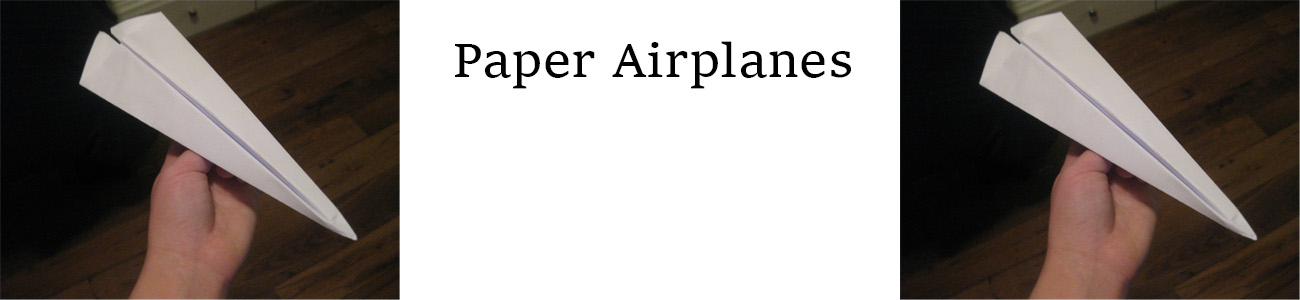
|
| planes!!! |
Paper airplanes occupy a strangely magical place in human imagination, a blend of childhood simplicity and aerodynamic sophistication that continues to fascinate people long after they’ve left school desks behind. The act of folding a sheet of paper into a flying machine feels almost like a small rebellion against the ordinary, a transformation of something mundane into something capable of gliding, swooping, and soaring. Even people who don’t consider themselves crafty or mechanically inclined often remember the first time they folded a crude dart and watched it sail across a room, discovering that a few creases could turn a flat sheet into a vessel of motion. That moment of flight, however brief, is a spark that has ignited countless experiments, competitions, and even scientific studies. The deeper one looks into the world of paper airplanes, the more it becomes clear that this simple pastime contains layers of physics, creativity, and personal expression that rival far more complex hobbies. The origins of paper airplanes stretch back centuries, long before modern aviation existed. Ancient China, where paper itself was invented, saw early experiments with folded paper gliders, though they were often used ceremonially rather than recreationally. In Japan, the tradition of origami eventually intersected with aerodynamic curiosity, giving rise to early folded gliders that were more art than engineering. But as humans began to dream of real flight, paper models became tools for imagining what might be possible. Leonardo da Vinci sketched designs for flying machines and used parchment models to test ideas about lift and drag. Later, in the early 20th century, as aviation pioneers like the Wright brothers experimented with gliders, paper models served as a low‑risk way to explore wing shapes and control surfaces. The paper airplane, in other words, has always been more than a toy; it has been a miniature laboratory for understanding the sky. What makes paper airplanes so compelling is the way they invite experimentation. A single sheet of paper contains infinite possibilities, limited only by the folder’s imagination and understanding of how air behaves. A slight change in wing angle can turn a fast dart into a gentle glider. A tiny bend at the tail can correct a nosedive or induce a graceful curve. Even the weight distribution—whether the nose is tightly compressed or loosely folded—can determine whether a plane flies straight, loops, or spirals. This responsiveness makes paper airplanes uniquely satisfying: every adjustment teaches something, and every flight provides feedback. Children discover this intuitively, adjusting folds without knowing the terminology of aerodynamics, while adults often rediscover it with a more analytical eye, realizing that the principles governing a paper airplane are the same ones that govern real aircraft. The physics behind paper airplanes is surprisingly rich. Lift, drag, thrust, and gravity all play roles, even though the plane has no engine. When thrown, the plane’s forward motion creates airflow over the wings, generating lift according to Bernoulli’s principle and Newton’s third law. The shape and angle of the wings determine how efficiently this lift is produced. A plane with long, wide wings tends to glide slowly and stay aloft longer because it maximizes lift while minimizing sink rate. A plane with narrow, swept‑back wings tends to fly faster and straighter because it reduces drag and channels airflow more aggressively. The center of gravity is equally important; if it’s too far forward, the plane dives, and if it’s too far back, the plane stalls. These principles mirror those used in designing real aircraft, which is why many aerospace engineers fondly recall folding paper airplanes as their first exposure to flight mechanics. But beyond physics, paper airplanes are deeply personal. People develop favorite designs, often passed down informally from friends, siblings, or parents. Some prefer the classic dart, a symbol of simplicity and speed. Others gravitate toward gliders that float gently across a room, tracing slow arcs that feel almost meditative. Still others enjoy stunt planes that loop, twist, or boomerang back toward the thrower. Each design reflects a different philosophy of flight: power versus grace, precision versus playfulness. And because paper is so accessible, anyone can experiment without fear of wasting materials or breaking expensive equipment. A mistake is just another sheet of paper, another chance to try again. The culture surrounding paper airplanes has grown far beyond casual folding. Competitions are held around the world, some focusing on distance, others on airtime, and still others on aerobatics. The current world record for distance—over 200 feet—was achieved with a design that looks deceptively simple but required meticulous refinement. Competitors often spend months perfecting their folds, testing different paper weights, and adjusting tiny details to optimize performance. In classrooms, teachers use paper airplanes to introduce concepts like force, motion, and symmetry, turning a playful activity into a hands‑on science lesson. In offices, paper airplanes become spontaneous stress relievers or tools for friendly rivalry, with coworkers launching impromptu contests across cubicles. The universality of paper airplanes—anyone can make one, anywhere—gives them a cultural reach that few hobbies can match. The emotional resonance of paper airplanes is equally powerful. They evoke nostalgia, reminding adults of childhood afternoons spent folding and flying without concern for precision or performance. They symbolize creativity, showing how something ordinary can become extraordinary with a few thoughtful folds. They represent freedom, however small, as they glide through the air unburdened by engines or electronics. Even the act of throwing a paper airplane carries a sense of release, a momentary letting go that mirrors the way people project hopes or frustrations into the air. In stories and films, paper airplanes often appear as metaphors for messages, dreams, or connections between people, their fragile flight capturing the delicate balance between intention and chance. Yet despite their simplicity, paper airplanes continue to evolve. Designers share new models online, pushing the boundaries of what folded paper can do. Some create planes that stay aloft for minutes at a time, exploiting thermal currents or ultra‑light materials. Others design planes that perform elaborate tricks, using unconventional folds or added flaps to manipulate airflow. There are even paper airplane kits with pre‑printed fold lines, weighted noses, or detachable wings, though purists often prefer the purity of a plain sheet of paper. The diversity of designs reflects the diversity of people who fold them: engineers, artists, children, hobbyists, and curious minds of all kinds. One of the most fascinating aspects of paper airplanes is how they reveal the relationship between structure and behavior. A plane that looks sleek may fly poorly if its folds are misaligned. A plane that appears awkward may glide beautifully if its weight distribution is perfect. This teaches a subtle lesson about not judging by appearances, but also about the importance of precision. A single millimeter of misalignment can cause a plane to veer off course, while a carefully sharpened nose can dramatically improve stability. These small details encourage patience and attention, qualities that are increasingly rare in a fast‑paced world. Folding a paper airplane becomes a quiet act of focus, a moment of craftsmanship in miniature. The process of learning to fold better planes mirrors the process of learning any skill. Beginners often start with simple designs, celebrating the first successful flight even if it wobbles or crashes. As they gain experience, they begin to notice patterns: how certain folds affect balance, how different papers behave, how throwing technique influences trajectory. They experiment, fail, adjust, and try again. This iterative cycle is at the heart of creativity and problem‑solving, making paper airplanes not just a pastime but a microcosm of learning itself. The satisfaction of seeing a plane fly well after multiple attempts is a reminder that persistence pays off, even in small endeavors. Paper airplanes also highlight the beauty of imperfection. No two sheets of paper are exactly alike, and no two folds are perfectly symmetrical. Even the best‑folded plane will eventually crumple or tear after repeated flights. But this fragility is part of the charm. Unlike durable toys or digital simulations, paper airplanes have a finite lifespan, which makes each flight feel more meaningful. Their impermanence encourages experimentation rather than perfectionism, inviting people to try bold designs without worrying about long‑term consequences. In a world where many activities are optimized, measured, and digitized, the ephemeral nature of paper airplanes feels refreshingly human. The social aspect of paper airplanes is another reason they endure. Folding and flying them often becomes a shared experience, whether between friends, classmates, coworkers, or family members. People compare designs, trade tips, and cheer each other on. A well‑thrown plane that glides across a room can spark laughter, applause, or friendly competition. Even strangers can bond over a shared appreciation for a particularly elegant flight. This communal joy is part of what makes paper airplanes timeless: they bring people together through simple, playful interaction. As technology advances, paper airplanes have found new roles. Some educators use them to teach coding or engineering by attaching lightweight sensors that track flight data. Others incorporate them into art installations, using mass flights of paper planes to create visual spectacles. There are even smartphone apps that simulate paper airplane physics, though many enthusiasts argue that nothing compares to the tactile experience of folding and throwing a real plane. The intersection of tradition and innovation keeps the hobby vibrant, blending old‑school creativity with |