
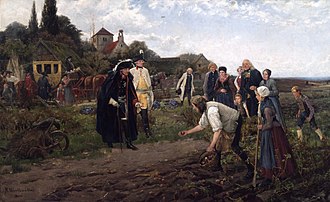
The History of PotatoesThe history of the potato begins in the high-altitude regions of the Andes Mountains, specifically around modern-day Peru and Bolivia. Here, the wild ancestor of the modern potato (Solanum tuberosum) thrived, and it was the indigenous peoples of the region who recognized its potential. Archeological evidence suggests that domestication occurred between 7,000 and 10,000 years ago along the Altiplano. These ancient Andean civilizations, including the Incas, developed sophisticated agricultural techniques to cultivate the tuber, preserving them as a crucial, long-lasting food source through processes like freeze-drying to create "chuño." The potato became a cornerstone of their diet and culture, enabling the growth of large, complex societies in a challenging mountainous environment. Spanish explorers and conquistadors first encountered the potato in the mid-16th century following their arrival in South America. They introduced the crop to Europe as part of the massive transatlantic transfer of plants and animals known as the Columbian Exchange. Initially, Europeans were hesitant to adopt the unfamiliar tuber, viewing it with suspicion and sometimes fear due to misconceptions about its edibility and an association with the poisonous nightshade family. However, the potato's resilience, high yield, and nutrient density gradually became apparent, and it eventually flourished in the cool, moist climates of Northern Europe, particularly in countries like Ireland, Germany, and Russia. The introduction of the potato had a transformative effect on global history. It provided a reliable and calorie-rich food source that required less land and labor compared to grains like wheat. This led to significant population booms across Europe during the 18th and 19th centuries, providing the essential labor force that fueled the Industrial Revolution. The potato effectively became a geopolitical tool and a foundational element of the global food supply, spreading from Europe to Asia, Africa, and North America, cementing its place as one of the world's most vital crops and profoundly shaping the course of human civilization. |
 |