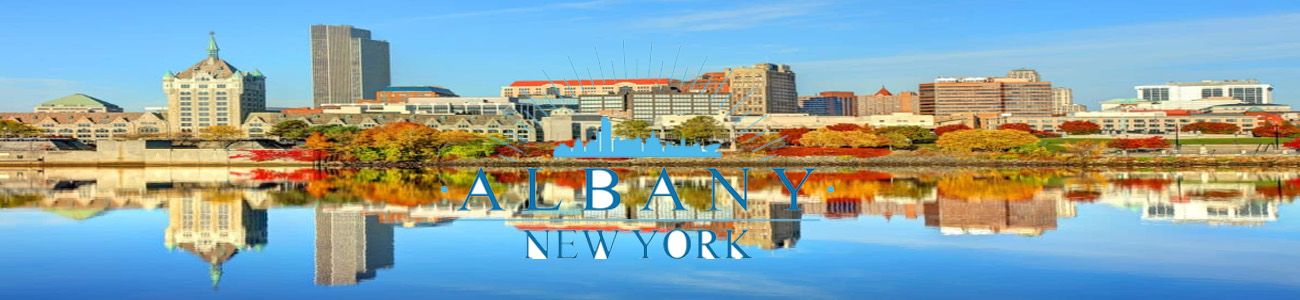
Albany, New York
Early History (1600s)
-
Before Europeans, the area was inhabited by the Mohican (Mahican) Native American tribe, who lived along the Hudson River.
-
In 1614, the Dutch established a fur-trading post called Fort Nassau, making Albany one of the oldest European settlements in the United States.
-
The settlement later became Fort Orange and was part of the Dutch colony of New Netherland.
British Control (1664–1775)
-
In 1664, the British took control of the region and renamed the city Albany, after the Duke of Albany (who later became King James II of England).
-
Albany became an important trading and military center, especially during conflicts between Britain, France, and Native American nations.
-
It grew as a gateway between the Atlantic coast and the interior of North America.
Revolutionary Era (1775–1783)
-
Albany supported the American Revolution and served as a strategic supply and military center.
-
After independence, New York became a state, and Albany was named the permanent state capital in 1797.
19th Century: Growth & Industry
-
The opening of the Erie Canal in 1825 transformed Albany into a major transportation and trade hub, connecting New York City to the Great Lakes.
-
The city industrialized, becoming known for iron works, printing, brewing, and lumber.
-
Albany developed strong political influence, especially through political machines like the Albany Regency.
20th Century: Change & Decline
-
Albany remained a government-centered city, but like many industrial cities, it faced economic decline after World War II.
-
In the 1960s, Governor Nelson Rockefeller launched massive redevelopment projects, including the Empire State Plaza, which dramatically reshaped downtown—sometimes controversially by displacing neighborhoods.
Modern Albany (Late 20th Century–Today)
-
Albany transitioned toward an economy based on government, education, healthcare, and technology.
-
It is now part of the Capital District, a regional metro area with universities, research centers, and growing tech industries.
-
The city balances its historic character with modern development and state government functions.
Why Albany matters historically
-
One of the oldest continuously settled cities in the U.S.
-
Played a key role in colonial trade, westward expansion, and state politics.
-
Has been New York’s capital for over 225 years.