The object of the game is to win money by creating card totals higher than those of the dealer's hand but not exceeding 21, or by stopping at a total in the hope that the dealer will bust. Number cards count as their number, the jack, queen, and king ("face cards" or "pictures") count as 10, and aces count as either 1 or 11 depending on whether or not counting it as 11 would cause a bust. If a player exceeds 21 points, they bust and automatically lose. A total of 21 on the starting two cards is called a "blackjack" or "natural,"[11][12] and is the strongest hand.[13][14]
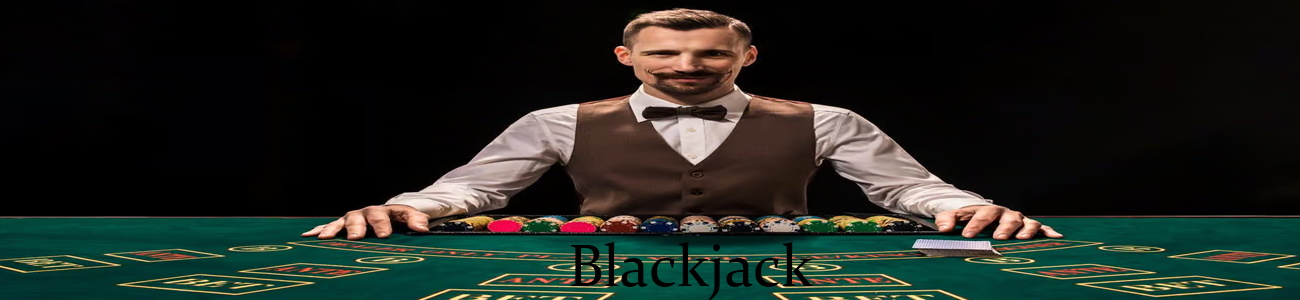
At a blackjack table, the dealer faces five to nine playing positions from behind a semicircular table. Between one and eight standard 52-card decks are shuffled together. To start each round, players place bets in the "betting box" at each position. In jurisdictions allowing back betting, up to three players can be at each position. The player whose bet is at the front of the betting box controls the position, and the dealer consults the controlling player for playing decisions; the other bettors "play behind". A player can usually bet in one or multiple boxes at a single table, but in many U.S. casinos, players are limited to playing one to three positions at a table.[15]
The dealer deals from their left ("first base") to their far right ("third base"). Each box gets an initial hand of two cards. The dealer's hand gets its first card face-up. In "hole card" games, the dealer also gets a second card face-down (the hole card), and if the first card is a 10-A, the dealer will peek at the hole card to see whether they have a blackjack. If they do, they reveal it immediately, the hand ends, and the dealer takes all wagers whose hands are not also a blackjack. Hole card games are sometimes played on tables with a small mirror or electronic sensor used to peek securely at the hole card.[13][14] In European casinos, "no hole card" games are prevalent; the dealer's second card is not drawn until all the players have played their hands.[citation needed]
Dealers deal the cards from one or two handheld decks, from a dealer's shoe or from a shuffling machine.[12] One card is dealt to each wagered-on position clockwise from the dealer's left, followed by one card to the dealer, followed by an additional card to each of the positions in play, followed by the dealer's hole card if applicable. The players' initial cards may be dealt face-up or face-down (more common in single and double-deck games).
Once all the hands are dealt, play begins with the player to the left of the dealer and proceeds clockwise.[12][13][14]