French fries, or simply fries, also known as chips, and finger chips, are batonnet or julienne-cut deep-fried potatoes of disputed origin. They are prepared by cutting potatoes into even strips, drying them, and frying them, usually in a deep fryer. Pre-cut, blanched, and frozen russet potatoes are widely used, and sometimes baked in a regular or convection 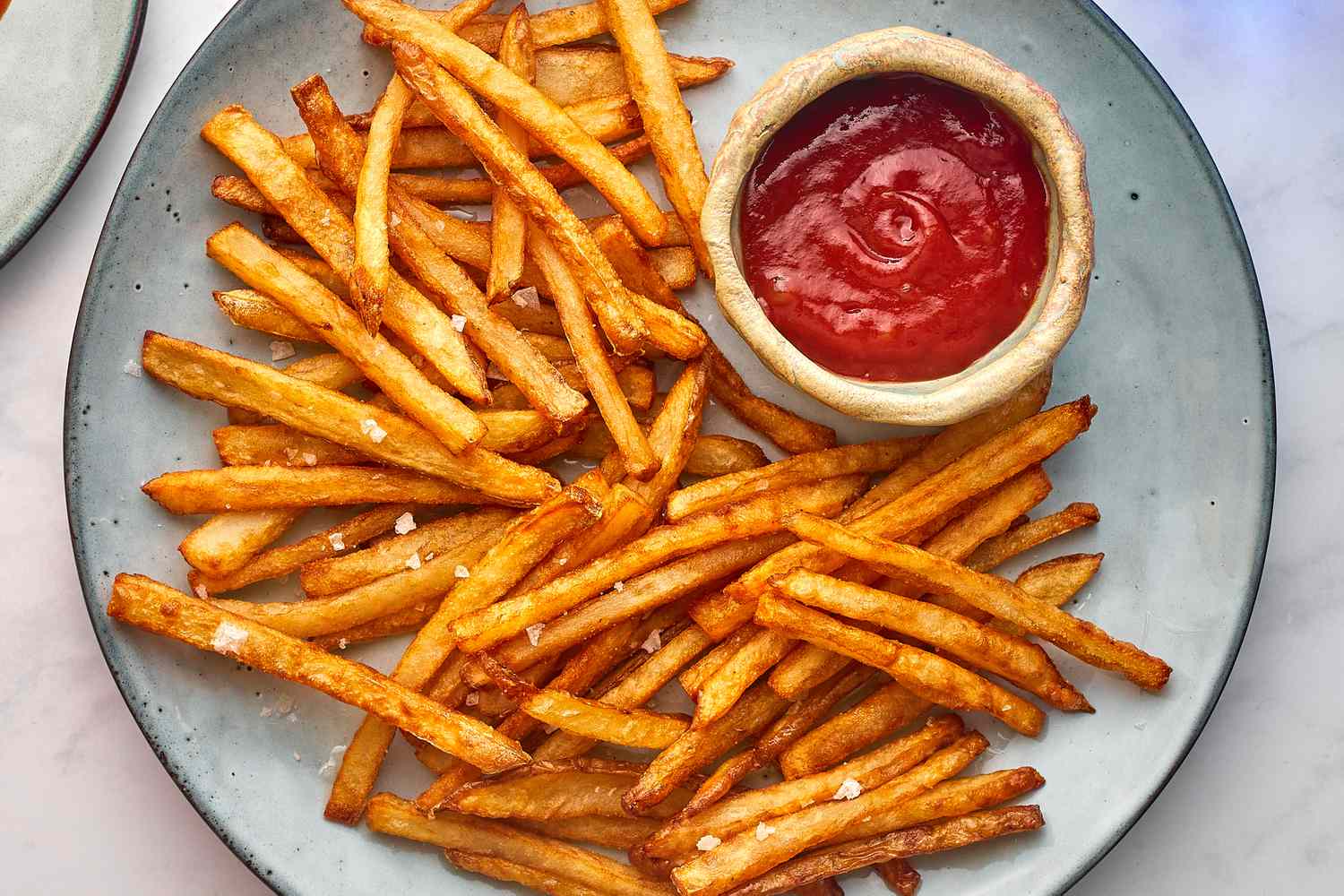 oven, such as an air fryer.
French fries are served hot, either soft or crispy, and are generally eaten as part of lunch or dinner or by themselves as a snack, and they commonly appear on the menus of diners, fast food restaurants, pubs, and bars. They are typically salted and may be served with ketchup, vinegar, mayonnaise, tomato sauce, or other sauces. Fries can be topped more heavily, as in the dishes of poutine, loaded fries or chili cheese fries, and are occasionally made from sweet potatoes instead of potatoes.
The standard method for cooking french fries is deep frying, which submerges them in a hot fat, typically oil.
The potatoes are prepared by first cutting them (peeled or unpeeled) into even strips, which are then wiped off or soaked in cold water to remove the surface starch, and thoroughly dried. They may then be fried in one or two stages. Chefs generally agree that the two-bath technique produces better results. Potatoes fresh out of the ground can have too high a water content resulting in soggy fries, so preference is for those that have been stored for a while.
In the two-stage or two-bath method, the first bath, sometimes called blanching, is in hot fat (around 160 °C/320 °F) to cook the fries through. This step can be done in advance. Then they are more briefly fried in very hot fat (190 °C/375 °F) to crisp the exterior. They are then placed in a colan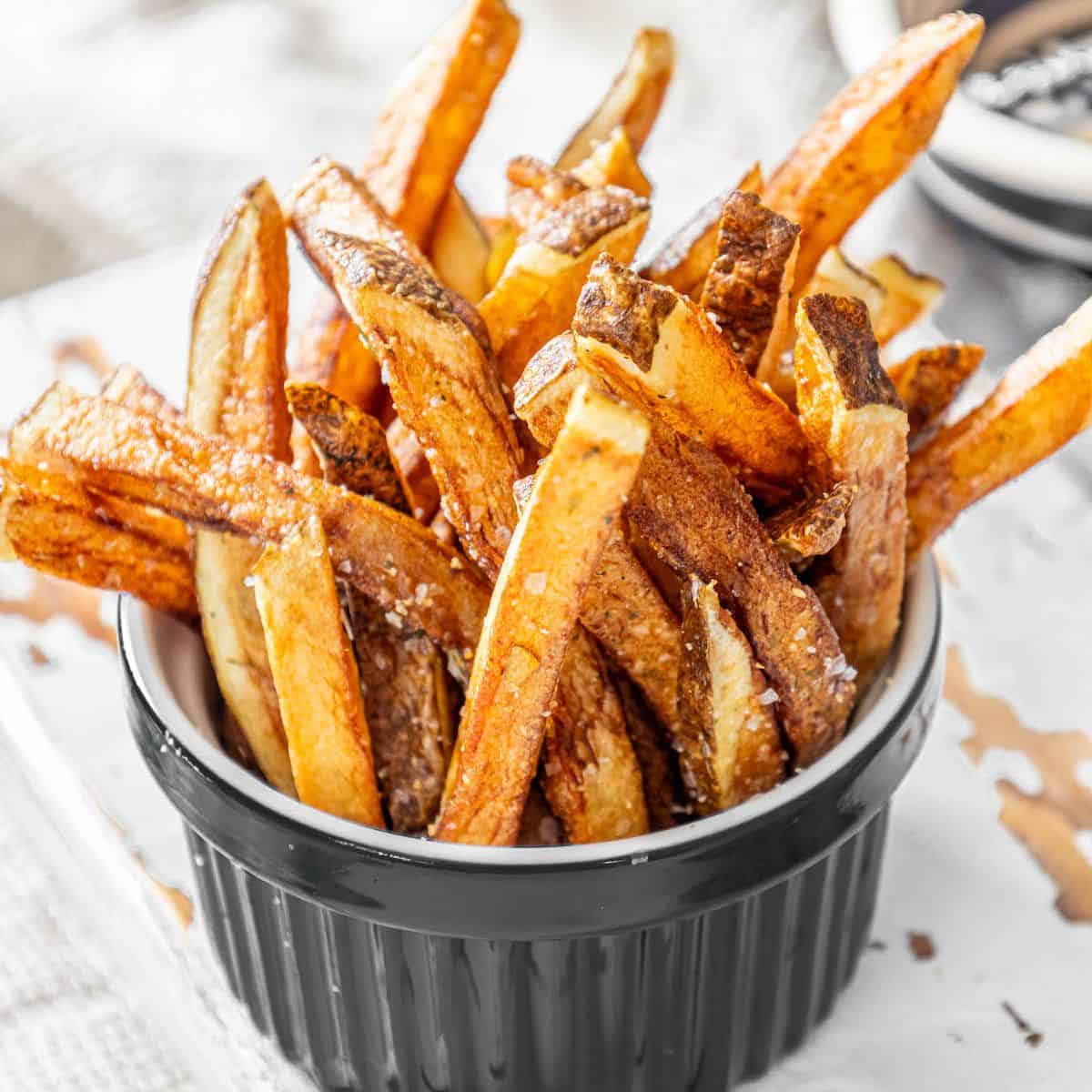 der or on a cloth to drain, then served. The exact times of the two baths depend on the size of the fries. For example, for 2–3 mm strips, the first bath takes about 3 minutes, and the second bath takes only seconds.
Since the 1960s, most french fries in the US have been produced from frozen Russet potatoes which have been blanched or at least air-dried industrially. The usual fat for making french fries is vegetable oil. In the past, beef suet was recommended as superior, with vegetable shortening as an alternative. McDonald's used a mixture of 93% beef tallow and 7% cottonseed oil until 1990, when they changed to vegetable oil with beef flavouring. Horse fat was standard in northern France and Belgium until recently, and is recommended by some chefs.
French fries are fried in a two-step process: the first time is to cook the starch throughout the entire cut at low heat, and the second time is to create the golden crispy exterior of the fry at a higher temperature. This is necessary because if the potato cuts are only fried once, the temperature would either be too hot, causing only the exterior to be cooked and not the inside, or not hot enough where the entire fry is cooked, but its crispy exterior will not develop. Although the potato cuts may be baked or steamed as a preparation method, this section will only focus on french fries made using frying oil. During the initial frying process (approximately 150 °C), water on the surface of the cuts evaporates off the surface and the water inside the cuts gets absorbed by the starch granules, causing them to swell and produce the fluffy interior of the fry.
The starch granules are able to retain the water and expand due to gelatinisation. The water and heat break the glycosidic linkages between amylopectin and amylose strands, allowing a new gel matrix to form via hydrogen bonds which aid in water retention. The moisture that gets trapped within the gel matrix is responsible for the fluffy interior of the fry. The gelatinised starch molecules move towards the surface of the fries "forming a thick layer of gelatinised starch" and this layer of pre-gelatinised starch becomes the crisp exterior after the potato cuts are fried for a second time. During the second frying process (approximately 180 °C), the remaining water on the surface of the cuts evaporates and the gelatinised starch molecules that collected towards the potato surface are cooked again, forming the crisp exterior. The golden-brown colour of the fry will develop when the amino acids and glucose on the exterior participate in a Maillard browning reaction.