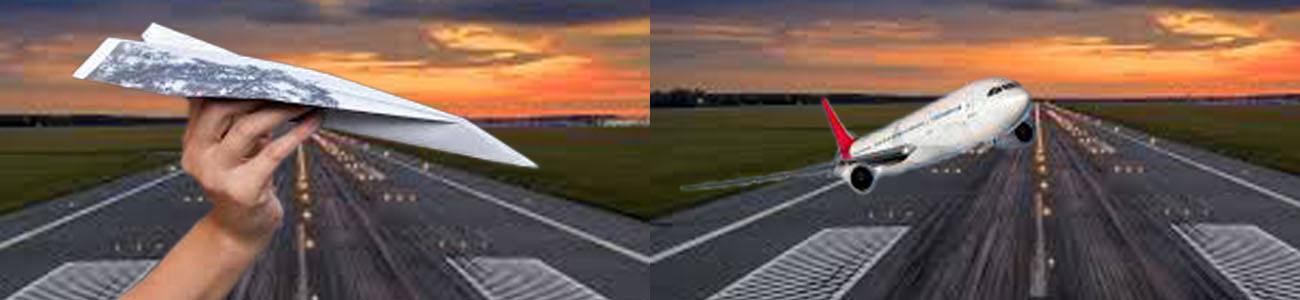
A paper plane (also known as a paper airplane or paper dart in American English, or paper aeroplane in British English) is a toy aircraft, usually a glider, made out of a single folded sheet of paper or paperboard. It typically takes the form of a simple nose-heavy triangle thrown like a dart.[1]
The art of paper plane folding dates back to the 19th century, with roots in various cultures around the world, where they have been used for entertainment, education, and even as tools for understanding aerodynamics.
The mechanics of paper planes are grounded in the fundamental principles of flight, including lift, thrust, drag, and gravity. By manipulating these forces through different folding techniques and designs, enthusiasts can create planes that exhibit a wide range of flight characteristics, such as distance, stability, agility, and time aloft. Competitions and events dedicated to paper plane flying highlight the skill and creativity involved in crafting the perfect design, fostering a community of hobbyists and educators alike.
In addition to their recreational appeal, paper planes serve as practical educational tools, allowing students to explore concepts in physics and engineering. They offer a hands-on approach to learning, making complex ideas more accessible and engaging. Overall, paper planes encapsulate a blend of art, science, and fun, making them a unique phenomenon in both childhood play and academic exploration.
History
Paper airplanes are known to have been made as far back as the mid 19th century, based on an American children's book describing their construction from 1864.[2]
The construction of a paper airplane, by Ludwig Prandtl at the 1924 banquet of the International Union of Theoretical and Applied Mechanics, was dismissed as an artless exercise by Theodore von Kármán:[3]
Prandtl was also somewhat impulsive. I recall that on one occasion at a rather dignified dinner meeting following a conference in Delft, Holland, my sister, who sat next to him at the table, asked him a question on the mechanics of flight. He started to explain; in the course of it he picked up a paper menu and fashioned a small model airplane, without thinking where he was. It landed on the shirtfront of the French Minister of Education, much to the embarrassment of my sister and others at the banquet.
In recent times, paper model aircraft have gained great sophistication, and very high flight performance far removed from their origami origins, yet even origami aircraft have gained many new designs over the years, and gained much in terms of flight performance.
There have been many design improvements, including velocity, lift, propulsion,[4] style, and fashion over subsequent years.
Advanced paper gliders
Developments
Paper gliders have experienced three forms of development in the period 1930–1988:
- High flight performance
- Scale modeling
- Use of CAD software
Ongoing development of folded/origami gliders over the same period has seen similar sophistication, including the addition of the following construction refinements
- Increased fold-count, sometimes of an intricate nature
- Explicit kirigami (cutting of paper) as a component of design
- Requirements for additional ballast to ensure flight performance
Technological introductions
Technology responsible[5] for the proliferation of advanced paper plane construction:
- Inexpensive CAD software for 2D part design
- Widespread manufacture, and inexpensive nature of acetal air-annealed glues, e.g. Bostik Clear-bond.
- Inexpensive ink and laser computer printers, for accurate aircraft part reproduction
- The advent of the Internet, and widespread information sharing
Material considerations
Compared to balsa wood — another material commonly used to fabricate model planes — paper's density is higher; consequentially, conventional origami paper gliders (see above) suffer from higher drag, as well as imperfectly aerodynamic wing chords.
However, unlike balsa gliders, paper gliders have a far higher strength-to-thickness ratio: a sheet of office-quality 80 g/m2 photocopier/laser printer paper, for example, has approximate in-scale strength of aircraft-grade aluminium sheet metal, while card stock approximates the properties of steel at the scale of paper model aircraft.[citation needed]
Directions in advanced paper aircraft design
Unmodified origami paper aircraft have very poor glide ratios, often not better than 7.5:1 depending on construction and materials. Modification of origami paper gliders can lead to marked improvements in flight performance, at the cost of weight and often with the inclusion of aerodynamic and/or structural compromises. Often, increases in wing loading can encourage breakdown of laminar flow over a wing with a hybrid of origami and glued and taped construction.
Professors Ninomiya and Mathews developed more directed design strategies in the late 1960s and the 1980s. Previously, paper model aircraft had been designed without an emphasis on performance in flight. By using aerodynamic design, and fluid dynamics, both professors were able to design models that exceeded previous flight performance criteria by a very wide margin. Ranges of flight increased from the typical 10+ meters to 85+ meters, depending on energy input into the gliders on launch.
At present, the work of the two professors remains the last serious research work on improving the flight performance of paper model gliders. Collaborative work by enthusiasts through online forums and personal websites are mostly developments of these original glider types.
In the field of scale model design, there are at present many possibilities for advanced design. Profile gliders encounter a limitation for improvement of flight performance based on their wing types, which are typically curved-plate aerofoils. In addition, fuselages are either balsa-paper or paper laminates, prone to warping or breakage over a very short time. Improvement in performance is possible through modelling three-dimensional fuselages which encourage laminar flow, and in internally braced wings which can then have high-lift aerofoil profiles, such as the Clark Y or NACA 4 or 6 series, for high lif