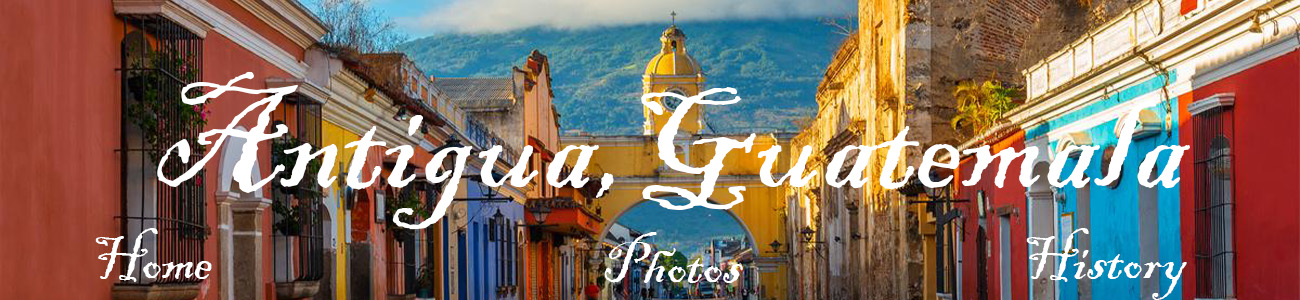
Antigua Guatemala (Spanish pronunciation: [anˈtiɣwa ɣwateˈmala]), commonly known as Antigua or La Antigua, is a city in the central highlands of Guatemala. The city was the capital of the Captaincy General of Guatemala from 1543 through 1773, with much of its Baroque-influenced architecture and layout dating from that period. These characteristics had it designated as a UNESCO World Heritage Site in 1979. Antigua Guatemala serves as the capital of the homonymous municipality and the Sacatepéquez Department.
Population
[edit] Central square of Antigua Guatemala in 1827.[3]
The city had a peak population of some 65,000 in the 1770s; the bulk of the population moved away in the late 18th century.[4] Despite significant population growth in the late 20th century, the city had only reached half that number by the 1990s. At the time of the 2007 census, the city had 34,685 inhabitants. [citation needed]
History
[edit] Façade of the former El Carmen church in 2009
Antigua Guatemala means "Old Guatemala" and was the third capital of Guatemala, formerly called "Santiago de los Caballeros de Guatemala".
The first capital of Guatemala was founded on the site of a Kaqchikel-Maya city, named Iximche, on Monday, July 25, 1524—the day of Saint James—and therefore named Ciudad de Santiago de los Caballeros de Guatemala (City of Saint James of the Knights of Guatemala). According to Catholic Tradition, St. James (Santiago) became the patron saint of the city.
After several Kaqchikel uprisings, the capital was moved to a more suitable site in the Valley of Almolonga (place of water) on November 22, 1527, and kept its original name. This new city was located on the site of present-day San Miguel Escobar,[5] which is a neighborhood in the municipality of Ciudad Vieja.[6] This city was destroyed on September 11, 1541, by a devastating lahar from the Volcán de Agua.[7] As a result, the colonial authorities decided to move the capital once more, this time eight kilometres (5 mi) away to the Panchoy Valley. So, on March 10, 1543, the Spanish conquistadors founded present-day Antigua, and again, it was named Santiago de los Caballeros.[8] For more than 200 years, it served as the seat of the military governor of the Spanish colony of Guatemala, a large region that included almost all of present-day Central America and the southernmost State of Mexico: Chiapas.
Santiago de los Caballeros was the third seat of the capital called kingdom of Guatemala, which included the current states of Guatemala, Belize, El Salvador, Honduras, Nicaragua and Costa Rica, besides modern state of Chiapas in Mexico. After a flood destroyed the second city, located in the Valley of Almolonga, on the slopes of Volcán de Agua, a new city was built in 1543 in the Valley of Panchoy, and it was established as head of the Real Audiencia of Guatemala in 1549.[9]
The city was laid out in a square pattern, with streets running north to south and from east to west, with a central square. Both church and government buildings were designated important places around the central plaza.[10][Note 1] Between 1549 and 1563, property southeast of the square was sold to the crown and occupied by the first president of the Real Audiencia de los Confines: the lawyer Alonso Lopez Cerrato, who also served as governor and captain general.[10][Note 2] The original building was small and paneled with portal, tile roof, and adobe walls. The city is surrounded by three enormous volcanoes and mountains, plains and hills. This territory was called Valley of Guatemala and had 73 villages, two towns and the city of Santiago de los Caballeros.[11]: 49
Due to constant problems between the conquerors and the representatives of the crown sent by the king of Spain, the Audiencia de los Confines was abolished in 1565.[Note 3] In 1570 the assembly was restored, this time independent of the viceroy of Mexico, and was called Audiencia of Guatemala.[11]: 50
The Franciscan friars were the first to move into the valley Panchoy, the new capital of the Kingdom of Guatemala, and built a chapel on the site where later the Church Escuela de Cristo would be erected. This primitive chapel was destroyed in 1575 by an earthquake and during the next ten years collections were made to build the new complex, two blocks from the previous one.[Note 4] The Franciscan complex became a major cultural and religious center for the entire Captaincy General of Guatemala. Theologians, jurists, philosophers, physicists, and mathematicians studied in the school of San Buenaventura, which was located where the monastery ruins are. Notable students included Cristóbal de Villalpando, Thomas Merlo, and Alonso de Paz.
 Mermaid Fountain, built by Diego de Porres in 1737,[12] Antigua Guatemala central square
The first building of a cathedral was begun in 1545 with the debris brought from the destroyed settlement in the valley of Almolonga; however, its construction was hampered by frequent earthquakes throughout the years.[13] The city was the final resting place of the great Spanish chronicler Bernal Díaz del Castillo, and his remains were interred in one of the churches that was eventually ruined by earthquakes.
The construction of the royal houses for the residence of the Captain General and the members of the Real Audiencia started in 1558; the complex also included the Royal Treasury, jail, Army quarters, the Hall of Arms, and the housing of Audiencia members.[10]